Why CTV Measurement Needs to Talk About Outcomes, Not Performance
Every conversation about Connected TV in India ends up at the same question. Did it work? Advertisers ask their agencies. Agencies ask their platforms. And the platforms answer with the same list of numbers: reach, impressions, viewability, completion rate, VTR, CPCV. These numbers are useful, and no CTV plan should be built without them. But the word usually attached to this list, performance, is the wrong word, and it is causing real confusion.
Performance suggests a straight line from someone seeing an ad to their buying something. That idea comes from search and social media, where a click can be tracked all the way to a purchase in the same sitting. CTV does not work like that. Treating it like it does means judging a brand-building channel by rules it was never meant to follow. A better word is outcomes. Outcomes cover what CTV is actually good at: making people consider a brand, helping them remember it, and moving them a step closer to buying, even if that happens three days later on a phone or a laptop.
What the Metrics Actually Tell You
Reach and impressions tell you how many households the ad reached. Viewability tells you whether people had a real chance to see it, and on CTV, that chance is usually high, since the ad takes over the full screen on platforms like JioHotstar, SonyLIV, ZEE5, and FAST channels, instead of getting lost in a scrolling feed. Completion rate and VTR tell you whether people watched the whole ad or dropped off halfway. CPCV tells you what that attention cost you.
None of these numbers tells you whether the campaign actually changed anything for the brand. They tell you the ad was delivered, not what it achieved. Most CTV measurement conversations in India go wrong right here, when a good completion rate gets treated as the end goal. A 95 percent completion rate only tells you people watched. It does not tell you if it made someone move from not knowing the brand to actually considering it.
Where the Real Outcomes Show Up
The real outcomes of a CTV campaign usually do not show up in the CTV report at all. They show up somewhere else, in numbers that a brand is already tracking.
Things like: how many more people searched for the brand name after the ad ran, how much direct traffic came to the website, or how the brand's search share moved on the e-commerce platforms where people actually buy the product. You can also see it in recall studies, where you compare people who saw the ad against a similar group who did not. And you can see it in incrementality studies, which show what CTV added on top of what other channels were already delivering.
This takes more effort than glancing at a dashboard. It means being patient and looking at results over days and weeks instead of expecting an instant answer. But it is a fair way to measure a channel that mostly works on brand building rather than instant sales. If a brand runs CTV to build familiarity before a big festive sale, it should not be judged on clicks, because CTV was never meant to generate clicks. It should be judged on whether more people were considering that brand once the festive season started.
India's CTV audience is still figuring out its own viewing habits. People are spread across JioHotstar for live sports and entertainment, SonyLIV and ZEE5 for regional shows, and a growing number of FAST channel viewers who behave differently from people who pay for a subscription.
Data from BARC keeps showing that this audience is genuinely new, not the same people just watching on a different screen, which is exactly the kind of value that gets missed when you only measure performance. If a brand only looks at last-click conversions, it ends up underselling the value of every new household CTV brings in, simply because those households were never going to buy on day one, no matter which channel reached them.
The fact that CTV in India is spread across so many apps and platforms makes this even more important, not less. The big platforms often limit how much advertisers can actually see about who they reached and how often. In a situation like that, chasing one performance number that nobody can measure consistently across platforms is not a smart use of time. It makes much more sense to track outcomes instead: brand lift, incremental reach, and what happens on search and the brand's website in the days after the ad runs. That gives advertisers one clear way to measure results, no matter which platform, publisher, or FAST channel delivered the ad.
A Simple Way to Think About It
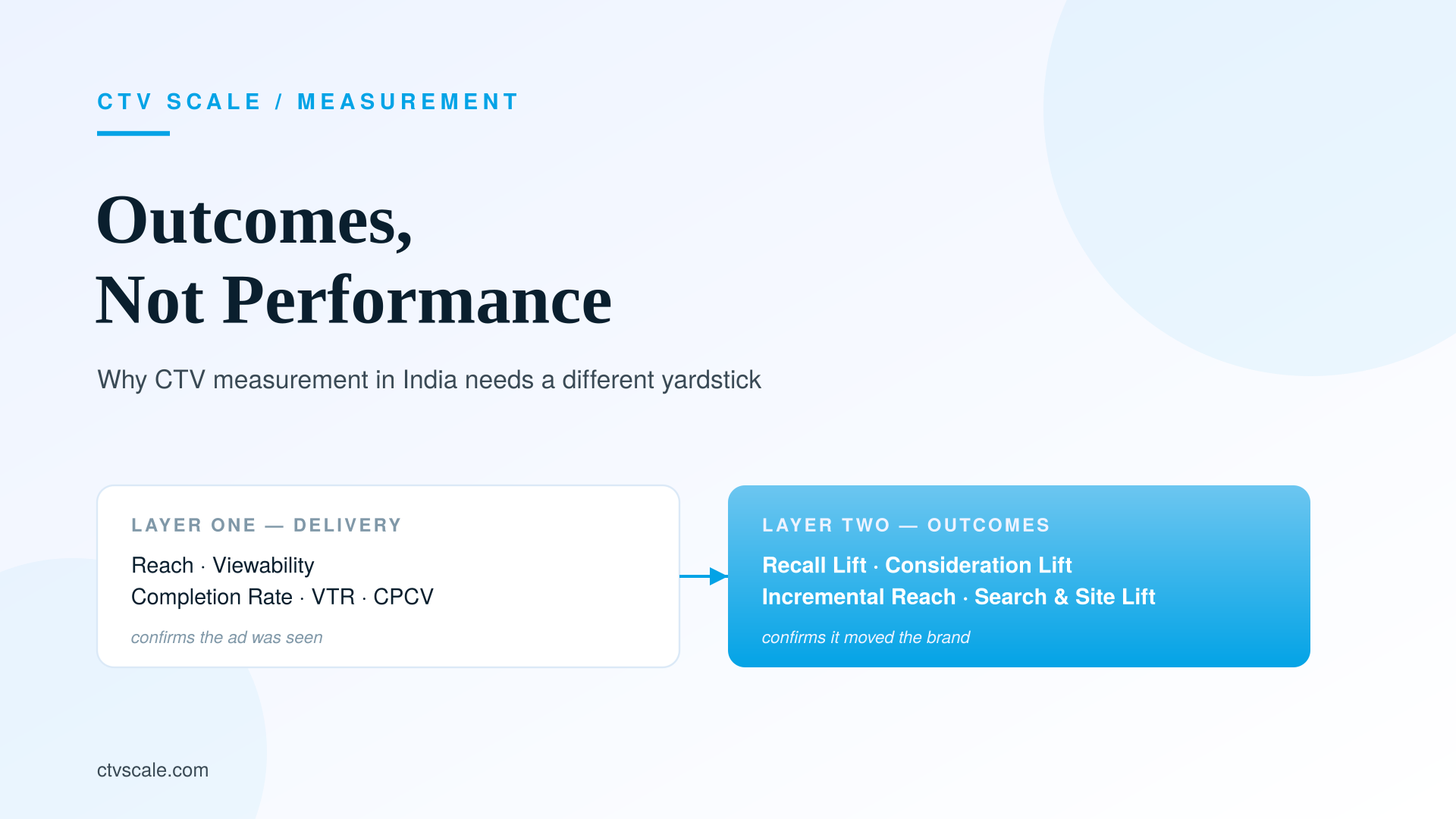
There are really just two layers to CTV measurement. The first layer is delivery. Did the ad reach the right households, did people actually see it, did they watch it? This is where reach, viewability, and completion rate belong, and platforms owe advertisers honest, clear reporting on these numbers. The second layer is outcomes. Did the campaign actually move the brand forward? This is where recall, consideration, incremental reach, and what happens on search and the website afterward all belong.
Both layers matter. But only the second layer really answers the question every advertiser is asking when they say they want to know if it worked. Once a brand gets comfortable with that difference and is willing to wait a bit longer for a real answer, it stops questioning its CTV budget every quarter and starts renewing it instead.
CTV was built to be a brand channel first. Measuring it by outcomes, instead of performance, is simply measuring it for what it actually is.