What's New ?
● CTV is not a medium, but an experience● Data, AI, and Innovation: Shaping the Future of Programmatic● The Growth Story Continues● CTV is not a medium, but an experience● Data, AI, and Innovation: Shaping the Future of Programmatic● The Growth Story Continues

Incremental Reach in CTV
Sonal Bhardwaj
3 min read

Incremental Reach in CTV

For years, the conversation between CTV and linear has been framed as a reach competition.

Who commands more homes, who moves more rating points, and who can fill a media plan with the kind of numbers that keep a planning committee comfortable? And in that framing, linear has always won not because it is the better medium, but because it has the longer history, the deeper agency relationships, and the measurement vocabulary that the industry built its entire buying logic around.


But that framing was always the wrong one. The question was never who has more reach. The question was always who has reached the other cannot replicate.


Incremental reach is what finally forces that distinction into the open. When a brand runs a campaign on linear and then measures what percentage of its CTV audience had zero exposure to that linear buy, the number is almost always surprising.


Not because CTV is reaching more people in aggregate, but because it is consistently reaching a different kind of person, younger, cord-cut or cord-never, consuming content on their own schedule on a screen that a traditional spot buy cannot touch. These are not the same viewers with a different remote in their hands. They are structurally unreachable through linear, and the only way to find them is through CTV.


This matters enormously to how we think about budget allocation. The instinct in most media plans, particularly in India, where linear still commands a significant share of video spend, is to treat CTV as an extension of the television buy. A top-up. A frequency driver for audiences already exposed to broadcast. And sometimes that is true and useful.


But the more interesting and commercially significant case is when CTV is not extending reach to the same audience but unlocking a population of viewers who simply do not appear on the GRP chart at all. A household that cancelled its DTH subscription and moved entirely to JioHotstar on their smart TV is not a linear audience that has migrated. It is a lost linear audience that CTV can recover, but only if the measurement framework is built to see them.


This is where the measurement argument becomes inseparable from the advertiser trust argument. Brands that have spent decades buying linear television have a deeply ingrained belief that television reach is GRP reach. If something is not showing up in BARC data, it is not reaching anyone worth reaching. CTV disrupts that belief, but it cannot simply assert disruption. It has to prove it with a metric that linear cannot manufacture. Incremental reach is that metric.

The sophistication of this argument is also its commercial power. When incremental reach data is clean and credible, when it comes from independent measurement rather than from the platform selling the inventory, it does something valuable for the entire category. It moves CTV out of the conversation about efficiency and into the conversation about necessity.


Efficiency arguments say CTV is a cheaper way to reach a television audience. Necessity arguments say there is an audience that does not exist anywhere else, and CTV is the only way to find them. One of those arguments competes with linear on price. The other makes linear irrelevant for a specific audience segment.


India is at an early but critical point in this shift. Smart TV penetration is growing fast, the connected home is becoming the norm in urban and increasingly in tier-2 markets, and streaming platforms are investing heavily in premium content that commands genuine attention. The conditions for incremental reach to become a defining metric are already in place.


That willingness is coming. And when it arrives in full, the brands that had already built their CTV strategy around incremental reach data will find themselves with a very different kind of advantage, not just better media efficiency, but a defensible claim to audiences their competitors cannot reach at all.

More Stories

5 Questions to ask your CTV vendor

5 Questions to ask your CTV vendor

6/29/2026|By Sonal Bhardwaj

The fastest way to judge a CTV vendor has nothing to do with the pitch deck. It's how long it takes them to answer a direct question. A vendor who knows their own supply chain answers in seconds. A vendor who needs to get back to you or steers the conversation toward a different slide is usually telling you something too, just not the thing you asked. CTV spend in India has grown faster than the infrastructure needed to hold vendors accountable for it. Budgets have moved from linear TV and digital video into connected TV at a pace most procurement teams have not had time to build proper diligence around. That gap gets filled by trust advertisers taking vendor decks at face value because there is not yet a standard set of questions everyone knows to ask, the way there is for search or programmatic display. That trust gets exploited quietly, and rarely through outright fraud. It is usually through vagueness: numbers that are technically true but framed in a way that hides the part that actually matters. A vendor can report impressive reach, strong completion rates, and healthy attribution numbers, all while sitting on a supply chain that would look very different if you asked to see the underlying data. So instead of another list of red flags, here are the five questions worth asking on every vendor call, why each one matters, and what a good answer should actually sound like. 1. What percentage of my spend is actually working media? When you hand a vendor a budget, that money does not go straight to buying impressions. A portion of it gets absorbed by platform fees, ad serving costs, data licensing, and agency margins before a single ad plays. What is actually left over, the part that buys inventory, is called working media, and it is the only number that reflects what your campaign is genuinely spending on reach. This matters because the gap between gross spend and working media can be substantial, and it's rarely disclosed unless asked for directly. A vendor with nothing to hide will give you this percentage without hesitation, because they have already calculated it internally. Somewhere in the 60-70% range is common depending on the technology stack involved, though it can vary based on how many platforms are stacked between your budget and the final impression. Anything meaningfully lower than that deserves a follow-up question about exactly where the rest of the money is going, and whether each fee attached to it is actually earning its place. 2. Can I see log-level impression data? Dashboards are built to tell a story. They roll thousands or millions of individual impressions into a handful of charts and summary metrics, almost all of which are designed to trend in a reassuring direction. That is not necessarily dishonest, but it is a curated version of the truth. A log file does not have that luxury. It lists every single impression individually, which app it ran in, what time of day it served, what device it reached, and what it cost. There is nowhere for a weak campaign to hide inside a log file the way it can inside a rounded-up summary chart. If a vendor can hand over that raw data without pushback, it is usually a sign they are confident in what it shows. If they can only offer a polished report, it's worth asking directly why the underlying data is not available. Sometimes that is a genuine platform limitation tied to how the ad server was built. Sometimes it is because the summary is doing a lot of quiet work that the raw logs would not support. 3. What percentage of my impressions ran on true CTV/OTT inventory? Streaming inventory has become one of the most elastic terms in Indian digital advertising right now, and that elasticity benefits the seller far more than the buyer. It can mean a premium show running on a Samsung Smart TV in someone's living room, or it can mean a mobile browser playing a video ad that technically qualifies as OTT because the same publisher also happens to run a streaming app. Both of those impressions can get billed at CTV rates, even though the experience, the attention level, and the actual value to the advertiser are nowhere close to the same. This distinction matters more in India specifically because the connected TV base is still growing and the definition of streaming has not been standardized the way it has in more mature markets. Ask specifically what share of your impressions ran on actual connected TV devices, as opposed to mobile, tablet, or desktop screens counted under the same streaming umbrella. And do not settle for a verbal percentage ask to see the device-level breakdown, because a number without the underlying split is just another version of the same vague reassurance. 4. Are you buying direct or through resellers? Every intermediary that sits between an advertiser's budget and the publisher's inventory supply-side platforms, resellers, sub-resellers takes a cut before the impression ever reaches its destination. None of that is inherently a problem. Some intermediaries add real value: better targeting technology, verification tools, access to inventory that would not otherwise be available. Others exist purely as arbitrage, adding a markup without adding anything the advertiser can point to. The issue is not the existence of resellers, it is the lack of visibility into how many of them are involved and what each one is charging for. A vendor who genuinely controls their supply chain should be able to map the path your budget takes, from your account to the final publisher, in a few sentences. A vendor who cannot, or who gets noticeably vague when asked, likely does not have full visibility into their own inventory sourcing either, which means neither do you. 5. What is your attribution methodology: 30, 60, or 90 days? When a vendor reports that a campaign drove a sale, that claim rests entirely on the attribution window they used to measure it, and that window quietly shapes how impressive the results look. A 30-day window is a relatively tight claim: if someone saw an ad and purchased a month later, there is a reasonable case the ad played some role. A 90-day window is a much looser one. A lot happens in a consumer's decision-making over three months that has nothing to do with an ad they scrolled past once. Longer windows produce bigger, more impressive-looking conversion numbers almost by mathematical default, simply because more purchases fall inside a wider net. That is precisely why some vendors default to longer windows without being asked, and why the question needs to be asked directly rather than assumed. Ask not just what the window is, but why that specific window was chosen for your category and purchase cycle. A genuinely considered methodology should have a real answer to that. None of these five questions are hard to answer for a vendor who actually controls their supply chain and stands behind their numbers. That is really the test running underneath all of them, not whether the answer sounds good, but whether it comes easily, with data attached rather than just reassurance. Vagueness on a straightforward, specific question is rarely an accident. It is usually the answer, just not the one that got said out loud.

Why CTV Measurement Needs to Talk About Outcomes, Not Performance

Why CTV Measurement Needs to Talk About Outcomes, Not Performance

6/29/2026|By Sonal Bhardwaj

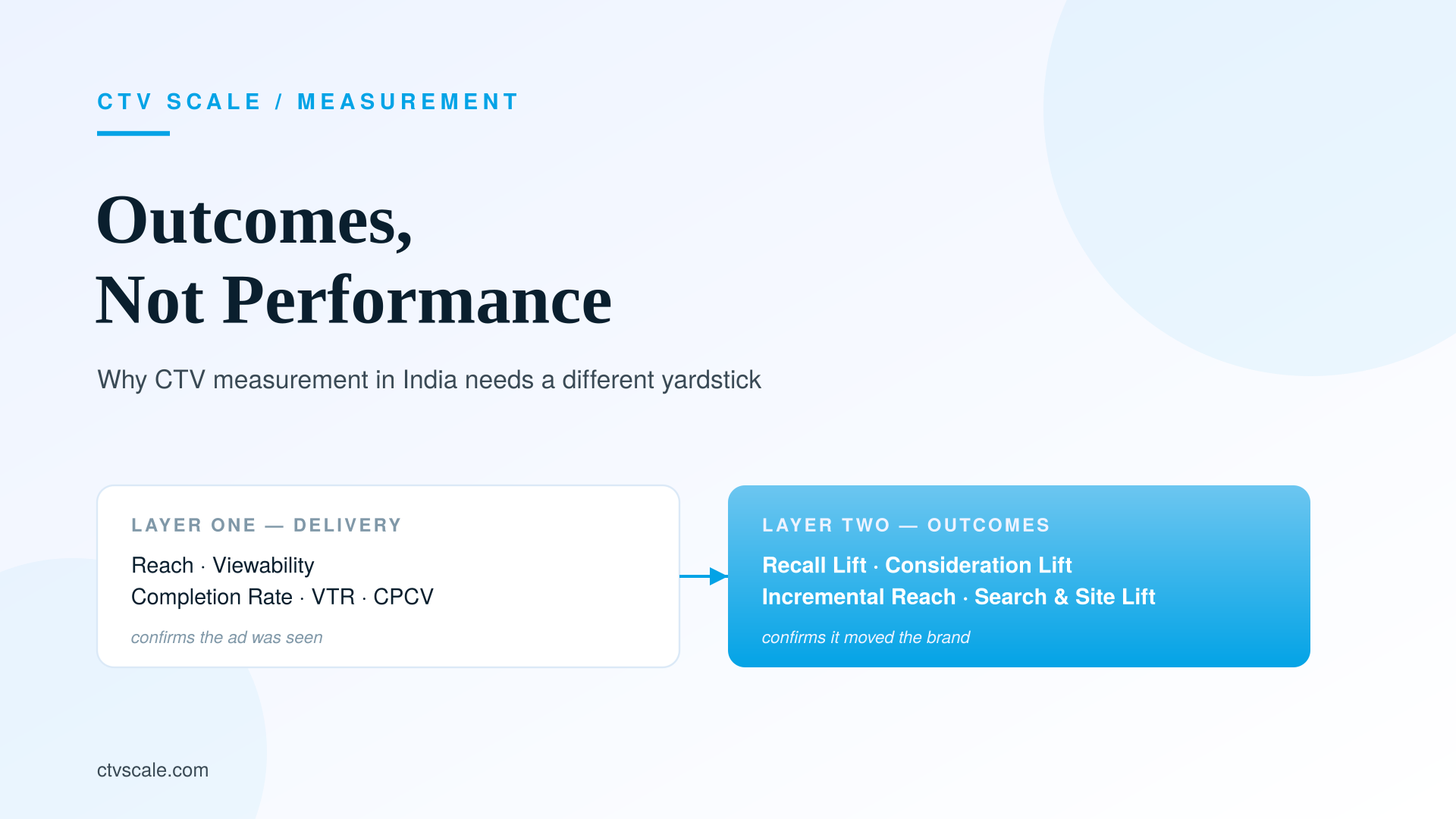
Every conversation about Connected TV in India ends up at the same question. Did it work? Advertisers ask their agencies. Agencies ask their platforms. And the platforms answer with the same list of numbers: reach, impressions, viewability, completion rate, VTR, CPCV. These numbers are useful, and no CTV plan should be built without them. But the word usually attached to this list, performance , is the wrong word, and it is causing real confusion. Performance suggests a straight line from someone seeing an ad to their buying something. That idea comes from search and social media, where a click can be tracked all the way to a purchase in the same sitting. CTV does not work like that. Treating it like it does means judging a brand-building channel by rules it was never meant to follow. A better word is outcomes . Outcomes cover what CTV is actually good at: making people consider a brand, helping them remember it, and moving them a step closer to buying, even if that happens three days later on a phone or a laptop. What the Metrics Actually Tell You Reach and impressions tell you how many households the ad reached. Viewability tells you whether people had a real chance to see it, and on CTV, that chance is usually high, since the ad takes over the full screen on platforms like JioHotstar, SonyLIV, ZEE5, and FAST channels, instead of getting lost in a scrolling feed. Completion rate and VTR tell you whether people watched the whole ad or dropped off halfway. CPCV tells you what that attention cost you. None of these numbers tells you whether the campaign actually changed anything for the brand. They tell you the ad was delivered, not what it achieved. Most CTV measurement conversations in India go wrong right here, when a good completion rate gets treated as the end goal. A 95 percent completion rate only tells you people watched. It does not tell you if it made someone move from not knowing the brand to actually considering it. Where the Real Outcomes Show Up The real outcomes of a CTV campaign usually do not show up in the CTV report at all. They show up somewhere else, in numbers that a brand is already tracking. Things like: how many more people searched for the brand name after the ad ran, how much direct traffic came to the website, or how the brand's search share moved on the e-commerce platforms where people actually buy the product. You can also see it in recall studies, where you compare people who saw the ad against a similar group who did not. And you can see it in incrementality studies, which show what CTV added on top of what other channels were already delivering. This takes more effort than glancing at a dashboard. It means being patient and looking at results over days and weeks instead of expecting an instant answer. But it is a fair way to measure a channel that mostly works on brand building rather than instant sales. If a brand runs CTV to build familiarity before a big festive sale, it should not be judged on clicks, because CTV was never meant to generate clicks. It should be judged on whether more people were considering that brand once the festive season started. India's CTV audience is still figuring out its own viewing habits. People are spread across JioHotstar for live sports and entertainment, SonyLIV and ZEE5 for regional shows, and a growing number of FAST channel viewers who behave differently from people who pay for a subscription. Data from BARC keeps showing that this audience is genuinely new, not the same people just watching on a different screen, which is exactly the kind of value that gets missed when you only measure performance. If a brand only looks at last-click conversions, it ends up underselling the value of every new household CTV brings in, simply because those households were never going to buy on day one, no matter which channel reached them. The fact that CTV in India is spread across so many apps and platforms makes this even more important, not less. The big platforms often limit how much advertisers can actually see about who they reached and how often. In a situation like that, chasing one performance number that nobody can measure consistently across platforms is not a smart use of time. It makes much more sense to track outcomes instead: brand lift, incremental reach, and what happens on search and the brand's website in the days after the ad runs. That gives advertisers one clear way to measure results, no matter which platform, publisher, or FAST channel delivered the ad. A Simple Way to Think About It There are really just two layers to CTV measurement. The first layer is delivery . Did the ad reach the right households, did people actually see it, did they watch it? This is where reach, viewability, and completion rate belong, and platforms owe advertisers honest, clear reporting on these numbers. The second layer is outcomes . Did the campaign actually move the brand forward? This is where recall, consideration, incremental reach, and what happens on search and the website afterward all belong. Both layers matter. But only the second layer really answers the question every advertiser is asking when they say they want to know if it worked. Once a brand gets comfortable with that difference and is willing to wait a bit longer for a real answer, it stops questioning its CTV budget every quarter and starts renewing it instead. CTV was built to be a brand channel first. Measuring it by outcomes, instead of performance, is simply measuring it for what it actually is.

The Pause Ad Problem on CTV

The Pause Ad Problem on CTV

6/29/2026|By Sonal Bhardwaj

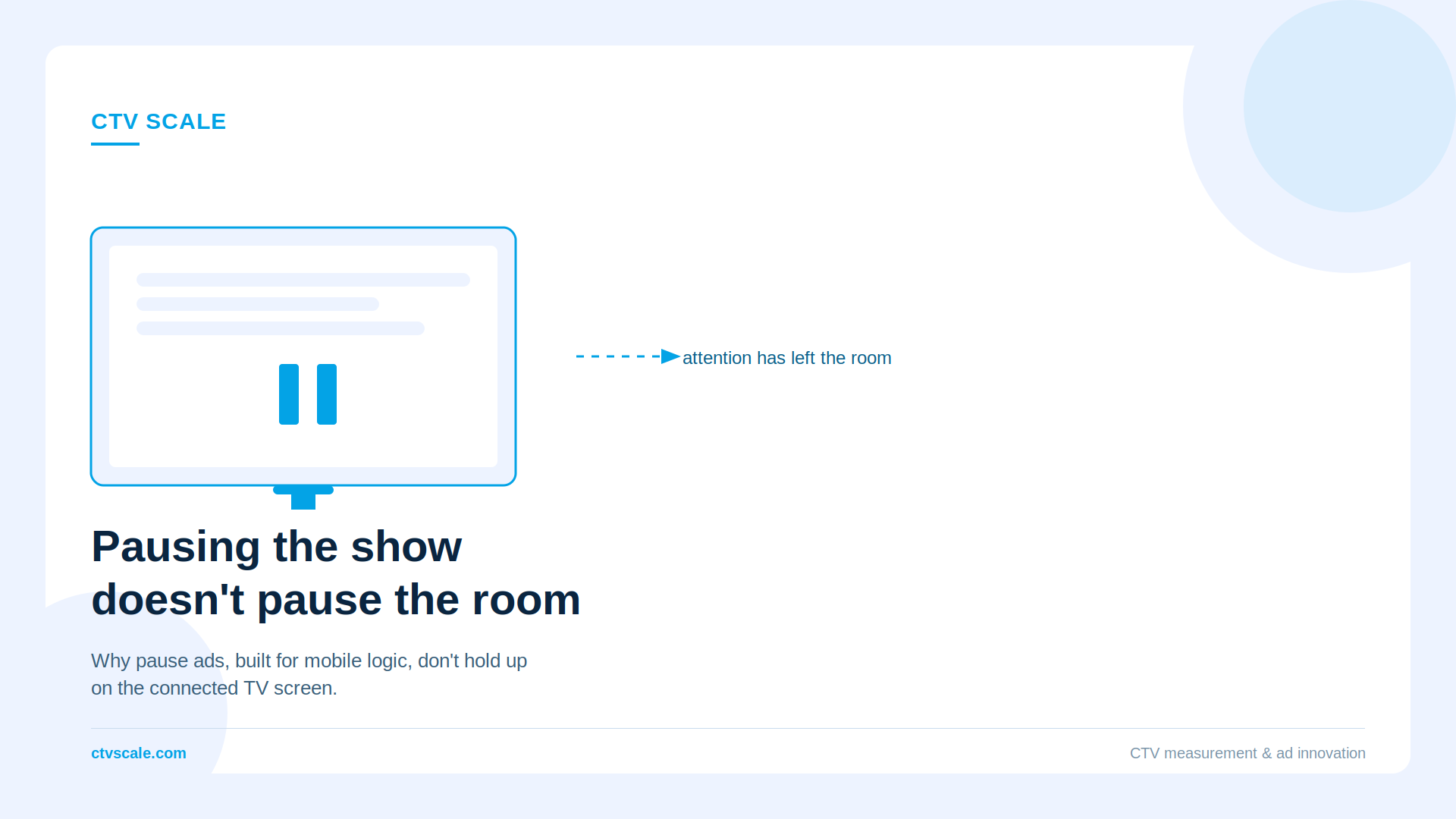
Pause ads have become a default line item in most CTV monetization decks. The logic sounds reasonable on paper. A viewer pauses, the screen goes idle, so why not fill that idle moment with a brand message. It is the kind of inventory that looks good in a rate card and even better in a sales deck, because on the surface it appears to solve a real problem. Dead airtime that would otherwise generate nothing . But the more this format gets scrutinized, the less sense it makes on a connected television, and the industry has largely borrowed the idea wholesale from other screens without asking whether the medium actually supports it. Start with what a pause actually signals, because the assumption baked into this format is that a pause behaves the same way regardless of device, and that assumption does not hold up. On mobile, a pause is often a deliberate, momentary interruption. The viewer is still holding the device, still nearby, still likely to glance back at the screen within seconds because the phone never really leaves their hand in the first place. On CTV, a pause usually signals something else entirely. Someone has stepped away from the room, picked up a phone call, gone to check on the kids, or gotten up to refill a drink. The remote is often nowhere near their hand, sometimes not even in the same room. Attention has not paused along with the content, it has left the room entirely, and often for several minutes rather than several seconds. Serving an ad into that gap is not reaching a viewer at all, it is reaching an empty living room and calling it engagement. Measuring an impression in that moment and reporting it as attention is where the format starts to quietly break down, and where the gap between what is billed and what is actually delivered starts to widen. The second problem is format thinking , and this is where the category has arguably failed the medium even more than it has failed the moment. Pause ads on CTV are, almost without exception, static banners lifted straight from mobile and desktop playbooks, resized and dropped onto a 55-inch screen with little else changed about them. That is a fundamental misreading of the canvas. A large screen viewed from eight feet away, often shared by more than one person in the household, is not a shrunk-down phone, and it never behaves like one. The viewing distance is different, the shared nature of the screen is different, and the expectations a household brings to that screen are different. Treating it like a phone wastes the one advantage CTV inventory is supposed to offer advertisers in the first place, which is scale and visual presence at a size no handheld device can replicate. No brand is actually being served well by a static creative sitting untouched on a paused frame, and no advertiser is getting the kind of impact that justifies CTV's premium pricing when the format itself is borrowed rather than built for the screen it sits on. This is not an execution gap that sharper creative work can fix on its own. It is a category thinking problem, and the ad innovation that CTV as a medium keeps promising simply has not been extended to this format at all. None of this means pause moments are worthless, and the answer is not to abandon the inventory but to rethink what it is actually for. Done differently, pause screens could work well, provided they are treated as contextual, non-intrusive placements that acknowledge the moment for what it is rather than pretending it is a captive viewing window with a guaranteed set of eyes on it. A pause screen could carry a QR-led offer aimed at someone who intends to return to the couch shortly rather than someone assumed to be watching in real time. It could carry a brand cue timed to when playback actually resumes, rather than firing the instant a viewer steps away. The difference, ultimately, comes down to designing for the interruption as it really happens, instead of designing around the illusion that attention is still sitting there, waiting, the whole time the screen is idle.

The Gap Between a Live FAST Channel and a Profitable One

The Gap Between a Live FAST Channel and a Profitable One

6/29/2026|By Sonal Bhardwaj

There is a problem playing out across nearly every FAST operator right now, and it is not really a content problem, even though it often gets treated like one. It is actually monetization and delivery, the unglamorous operational layer underneath the channel, failing to keep pace with how fast the format is growing. Channels go live faster than the systems running them can mature, and the gap between the two is where revenue quietly leaks out. The growth numbers explain the pressure. FAST is on track to cross 1,960 channels in 2025, up 21% in a single year. To a viewer, none of that complexity registers open the app, and a channel is already playing, no subscription, no login wall, no friction at all. That ease is the whole pitch, and it is why FAST has scaled the way it has. But on the operator's side, every one of those nearly two thousand channels carries a real operational load that the simplicity on screen completely hides. Programming grids have to stay consistent across time zones without manual patchwork. EPGs have to update automatically and accurately, because a guide that drifts out of sync erodes viewer trust fast. Ad markers have to land precisely because even small placement errors quietly suppress fill rates over time. Rights windows have to be tracked and enforced by region, content has to be refreshed often enough that a channel does not go stale within a few weeks of launch, and every platform it sits on, Roku, Samsung, LG, Amazon, JioHotstar, comes with its own submission specs and technical quirks that have to be met individually. None of this is difficult to manage at a small scale. An operator running three or four channels can hold it together with a spreadsheet and one dedicated person paying close attention. The trouble starts at scale, when that same operator is running twenty, thirty, forty channels across multiple platforms and regions, and the operational load multiplies far faster than the team does. That is when the cracks start showing up in places that matter most, which are fill rates that should be higher than they are, impressions that cannot be cleanly accounted for, and advertisers who hesitate to commit larger budgets because they cannot get reliable proof of delivery. The channel is live, the content is good, the audience is there, and the revenue still underperforms because the operational layer beneath it is not holding. This is also where the conversation about FAST starts to converge with the broader measurement and transparency conversation that has been building across CTV. Operational gaps in grid management, EPG accuracy, and ad marker placement are exactly the kind of blind spots that turn into bigger problems downstream misreported delivery, fraud that is hard to catch because the underlying data was never clean to begin with, and advertisers who cannot get a straight answer about what they actually bought. FAST does not have a viewer problem. It has an infrastructure problem. This is the gap CTV Scale is built to close. We work with operators on exactly the parts of FAST that determine whether a channel actually monetizes the way it should clean ad markers that protect fill rates instead of quietly eroding them, EPG accuracy that platforms and advertisers can trust without question, and grid and rights management that does not drift out of sync as a slate expands across regions and platforms. The goal is not simply keeping channels live, but rather it is making sure every one of them is operating cleanly enough to be sold with confidence and defended the moment an advertiser asks for proof of delivery. Done properly, that kind of operational discipline does not just protect revenue, but it also grows it, channel by channel, without requiring an operator to keep adding headcount at the same rate they are adding channels. FAST does not need fewer channels. It needs operations and monetization infrastructure that can actually keep pace with its growth, and that is precisely the problem CTV Scale exists to solve.