The Pause Ad Problem on CTV
Pause ads have become a default line item in most CTV monetization decks. The logic sounds reasonable on paper. A viewer pauses, the screen goes idle, so why not fill that idle moment with a brand message. It is the kind of inventory that looks good in a rate card and even better in a sales deck, because on the surface it appears to solve a real problem.“Dead airtime that would otherwise generate nothing”.
But the more this format gets scrutinized, the less sense it makes on a connected television, and the industry has largely borrowed the idea wholesale from other screens without asking whether the medium actually supports it.
Start with what a pause actually signals, because the assumption baked into this format is that a pause behaves the same way regardless of device, and that assumption does not hold up. On mobile, a pause is often a deliberate, momentary interruption.
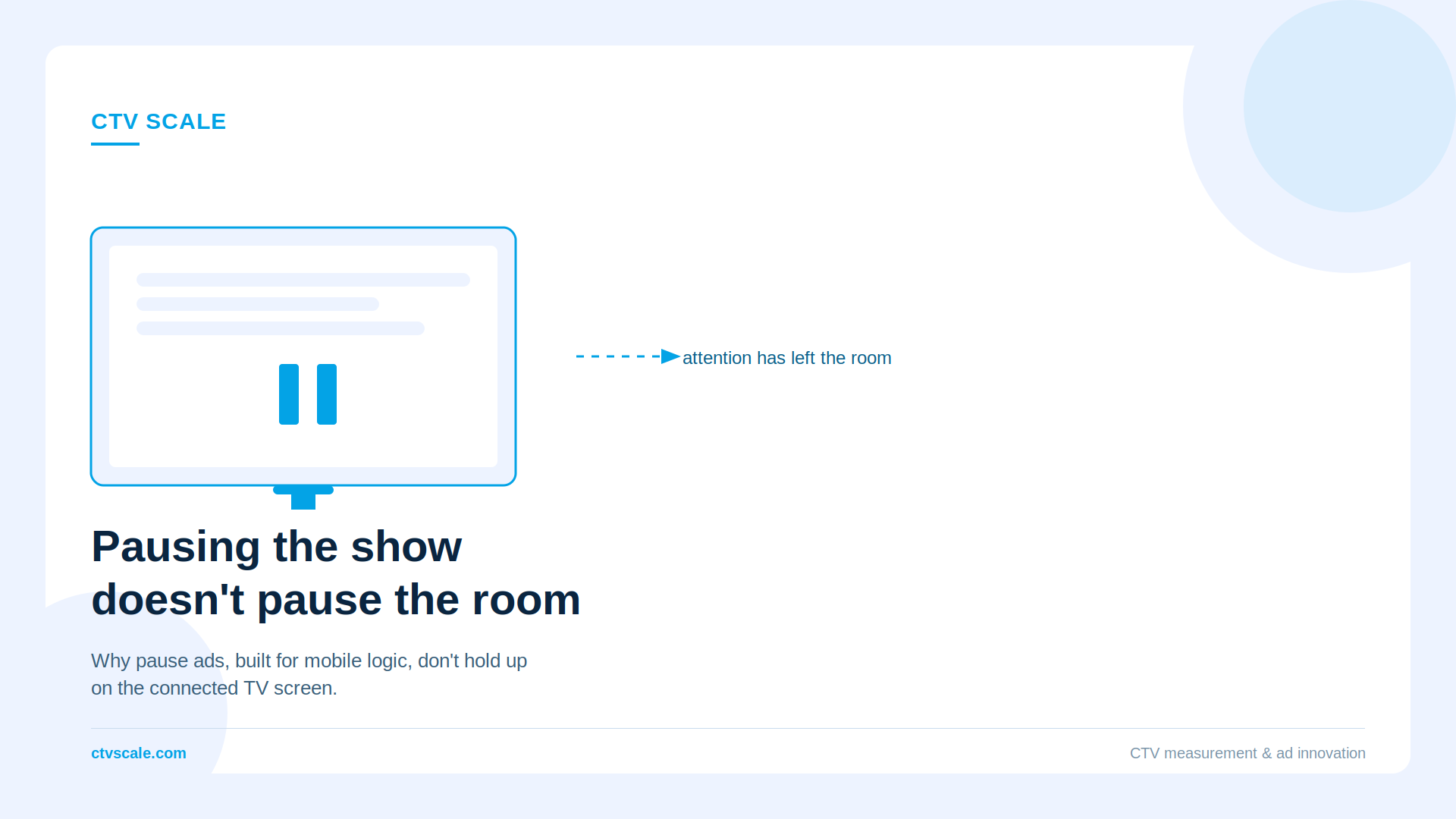
The viewer is still holding the device, still nearby, still likely to glance back at the screen within seconds because the phone never really leaves their hand in the first place. On CTV, a pause usually signals something else entirely. Someone has stepped away from the room, picked up a phone call, gone to check on the kids, or gotten up to refill a drink.
The remote is often nowhere near their hand, sometimes not even in the same room. Attention has not paused along with the content, it has left the room entirely, and often for several minutes rather than several seconds. Serving an ad into that gap is not reaching a viewer at all, it is reaching an empty living room and calling it engagement. Measuring an impression in that moment and reporting it as attention is where the format starts to quietly break down, and where the gap between what is billed and what is actually delivered starts to widen.
The second problem is format thinking, and this is where the category has arguably failed the medium even more than it has failed the moment. Pause ads on CTV are, almost without exception, static banners lifted straight from mobile and desktop playbooks, resized and dropped onto a 55-inch screen with little else changed about them.
That is a fundamental misreading of the canvas. A large screen viewed from eight feet away, often shared by more than one person in the household, is not a shrunk-down phone, and it never behaves like one. The viewing distance is different, the shared nature of the screen is different, and the expectations a household brings to that screen are different.
Treating it like a phone wastes the one advantage CTV inventory is supposed to offer advertisers in the first place, which is scale and visual presence at a size no handheld device can replicate. No brand is actually being served well by a static creative sitting untouched on a paused frame, and no advertiser is getting the kind of impact that justifies CTV's premium pricing when the format itself is borrowed rather than built for the screen it sits on. This is not an execution gap that sharper creative work can fix on its own. It is a category thinking problem, and the ad innovation that CTV as a medium keeps promising simply has not been extended to this format at all.
None of this means pause moments are worthless, and the answer is not to abandon the inventory but to rethink what it is actually for. Done differently, pause screens could work well, provided they are treated as contextual, non-intrusive placements that acknowledge the moment for what it is rather than pretending it is a captive viewing window with a guaranteed set of eyes on it.
A pause screen could carry a QR-led offer aimed at someone who intends to return to the couch shortly rather than someone assumed to be watching in real time. It could carry a brand cue timed to when playback actually resumes, rather than firing the instant a viewer steps away. The difference, ultimately, comes down to designing for the interruption as it really happens, instead of designing around the illusion that attention is still sitting there, waiting, the whole time the screen is idle.