
CTV vs Traditional TV Advertising: What Brands Need to Know?
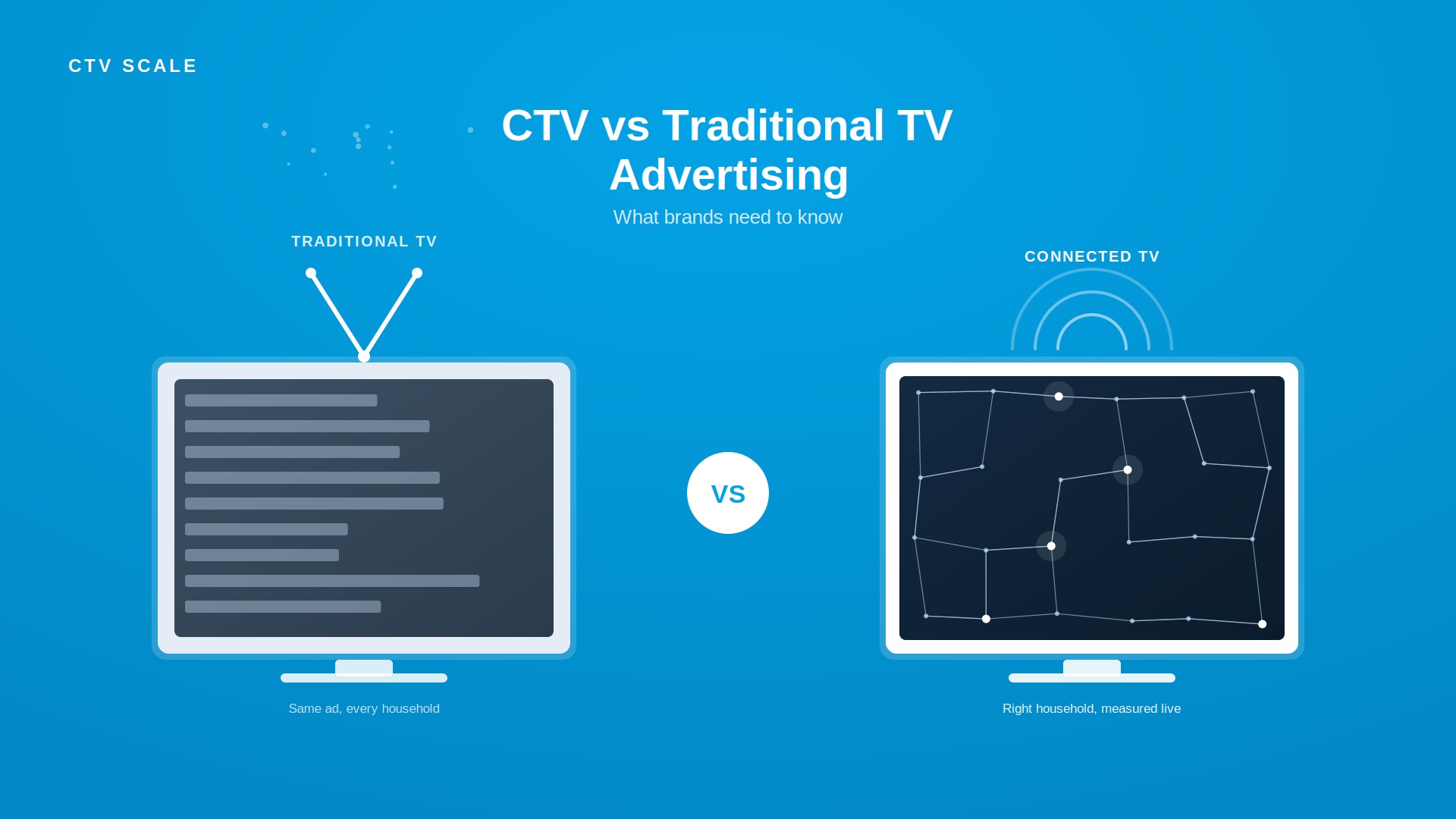
"CTV is not a departure from television advertising. It's television advertising finally living up to its full potential."
Television has always been the most powerful advertising medium ever created. The big screen, the lean-back attention, the shared household moment, the storytelling canvas, nothing else comes close. Brands have known this for decades, and that is why TV has commanded the lion's share of premium advertising budgets for as long as most marketers can remember.
So when people ask CTV vs. Traditional TV, what should brands know? The most honest answer is this: there is not really a versus. Connected TV is the same television you have always believed in, now running on smarter rails. Same screen. Same room. Same audience attention. Just with tools that were never available before.
Think of it the way you had thought of any great upgrade. A printed map and GPS navigation both get you to the same destination. But one of them knows traffic, recalculates when you take a wrong turn, and learns your commute over time. CTV is GPS for television advertising.
The Living Room has not changed. The Intelligence Behind It Has.
The most important thing to understand about CTV is what has not changed. Viewers are still sitting on their sofas. The television is still the centrepiece of the living room. Families still gather around it. Ads still run in full-screen, with full audio, within professionally produced content environments. The brand-safe, premium, high-attention context that made TV advertising great? That's fully intact.
What has changed is everything happening behind the scenes. Traditional linear TV broadcasts the same ad to every household watching a channel at the same time. It was powerful because of reach, and reach alone. CTV retains that reach and then layers on capabilities that were simply impossible in a broadcast world.
CTV preserves every strength on which television advertising was built, while adding the precision and accountability that modern brands demand.
The shift is not from TV to digital. It is from TV as a broadcast instrument to TV as an intelligent platform. Every CTV impression carries data. Every view tells a story. Every campaign becomes smarter in real time. And one should not take it as a threat to television's legacy because it's the fulfillment of it.
What Intelligent Television Actually Looks Like
When brands invest in CTV advertising, they are accessing the same premium inventory they always have, just with a new layer of intelligence built in.
Audience Targeting, Not Just Channel Buying.
Traditional TV buying meant purchasing time on a channel and trusting demographic averages. CTV lets advertisers define their audience precisely by age, interests, viewing behaviour, purchase intent, geography, and more, and reach them wherever they stream, regardless of the channel or platform.
Real-Time Performance Measurement
With linear TV, campaign performance arrived weeks after the fact through panel-based estimates. CTV delivers live dashboards: impressions served, completion rates, unique reach, cost per completed view, and downstream conversions. Brands know what is working while the campaign is still running.
Frequency Management Across Screens
One of linear TV's persistent blind spots was over-frequency, the same viewer seeing the same ad twelve times in a week. CTV solves this by tracking exposures at the individual level, capping frequency intelligently so every impression adds value rather than creating fatigue.
Incremental Reach for Linear Campaigns
Rather than replacing linear TV spend, CTV extends it. By identifying households that are underexposed or not reachable through traditional broadcast, CTV fills the gaps, reaching cord-cutters, streaming-first audiences, and younger demographics who are simply not present on linear TV anymore.
Flexible Budget Control
Premium television advertising once required large upfront commitments. CTV brings flexible, programmatic buying to the big screen, allowing brands of every size to access premium TV inventory with real-time budget control and performance-based optimisation.
Television's Evolution, Not Its Replacement
It helps to think of CTV not as a new medium but as the latest chapter in television's long evolution. Television itself has been evolving since its earliest days, from black and white to colour, from analogue to HD, from rabbit ears to cable boxes, from appointment viewing to DVR. Each evolution expanded what television could do for both viewers and brands.
CTV is simply the next chapter. The internet has become the distribution layer for television content, and that connectivity has unlocked capabilities that were not technically possible with broadcast infrastructure. But the experience for the viewer and the opportunity for the advertiser remain fundamentally televisual. It's the big screen. It's the living room. It's full-sound, full-screen, premium storytelling.
"The medium has not changed. The intelligence powering it has. That's the only distinction that matters for brands."
TV's Core Strength |
How Linear TV Delivered It |
How CTV Elevates It |
|
Brand-safe, premium environment |
Professionally produced broadcast content |
Same premium content, plus verified brand safety at the impression level |
|
Massive reach |
National broadcast to millions simultaneously |
Reaches linear audiences plus cord-cutters and streaming-native households |
|
High-attention viewing |
Lean-back, living room environment |
Same environment, with data confirming completion rates above 95% |
|
Emotional storytelling |
30- and 60-second narrative spots |
Same formats, with interactive and shoppable extensions available |
|
Audience targeting |
Demographic estimates via panels |
First- and third-party data at the individual household level |
|
Campaign measurement |
GRP-based post-campaign estimates |
Real-time dashboards with attribution, conversions, and incremental reach |
For Brands: This Is Still Television. Treat It Like Television.
The practical implication for brand teams and media planners is straightforward: CTV deserves the same creative ambition, the same premium positioning, and the same strategic weight as any television campaign. Because it is a television campaign.
Brands that have been cautious about shifting budgets toward streaming because it feels unfamiliar should reframe the question entirely. You are not moving your television budget to a digital channel. You are keeping your television budget on television, a smarter television that knows who is watching, measures every impression, and reaches the audiences that broadcast can no longer find.
A great 30-second spot that builds brand emotion and tells a compelling story works on CTV exactly as it works on linear TV because it appears on the same screen, in the same living room, watched by the same type of engaged viewer. What CTV adds is the confidence of knowing your story reached the right person, at the right frequency, and the data to prove the impact.
A Converged Future, Not a Fragmented One
The smartest approach for brands today is not to choose between linear TV and CTV, it is to use them together as a unified television strategy. Linear TV provides the broad, simultaneous reach of a national broadcast moment. CTV extends that reach to the audiences linear can no longer touch, fills frequency gaps, and provides the measurement layer that makes the combined investment provably effective.
This convergent approach is exactly what the CTV Scale is built to enable. By bringing together premium CTV inventory, data-driven audience targeting, real-time measurement, and seamless integration with linear TV campaigns, CTV Scale ensures that brands get the full power of television, not a fractured piece of it.
Television did not stop being television when it moved to streaming. It got better at being television. The brands that recognise this earliest will be the ones who capture the attention of the audiences everyone else can no longer reach, and do it with the proof to show exactly what that attention was worth.

.jpg)